
Meteorites are often called “space rocks,” but that phrase hardly captures what they truly are. Each authentic meteorite is a fragment of deep time formed long before Earth itself, shaped by violence in space, and altered forever by its passage through our atmosphere.
Over the years, I’ve handled meteorites from deserts, old collections, and private finds. Some were unmistakably real the moment they touched my hand. Others, despite convincing appearances, revealed themselves as something far more ordinary.
✓ Collector-grade specimens ✓ Verified provenance ✓ Educational guide
Why Identifying Authentic Meteorites Matters
One of the first lessons any collector learns is that meteorites are far rarer than people expect and imitations far more common. Industrial slag, volcanic stones, and weathered Earth rocks are frequently mistaken for visitors from space.
The difference matters. Authentic meteorites carry scientific value, historical context, and a permanence that ordinary stones do not. Once misidentified material enters a collection, its story — and its integrity — is lost.
What Real Meteorites Tend to Reveal
Authentic meteorites often share subtle characteristics that become easier to recognize with experience.
The surface, for example, is rarely dramatic. Fusion crusts are thin and understated — darkened skins formed during atmospheric entry, not glossy coatings or bubbly textures. Weight is another quiet indicator. Most meteorites feel unexpectedly dense, as if gravity has a firmer grip on them.
Iron meteorites sometimes bear shallow thumbprint-like depressions, shaped by extreme heat and airflow. Stony meteorites, on the other hand, may show faint internal structures — chondrules — that hint at their primordial origins.
None of these features alone are proof. Together, they begin to tell a story.
The Main Families of Meteorites
Over time, collectors come to recognize three broad families:
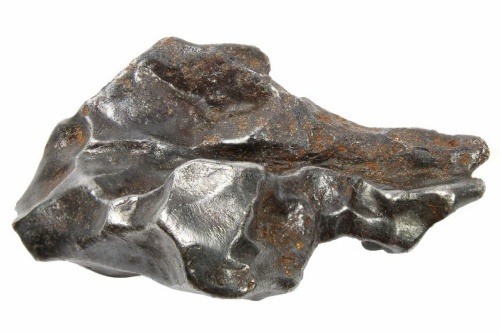
Iron Meteorites are often the most immediately convincing — heavy, magnetic, and enduring. Many reveal intricate internal patterns when cut and etched, structures that cannot be replicated artificially.
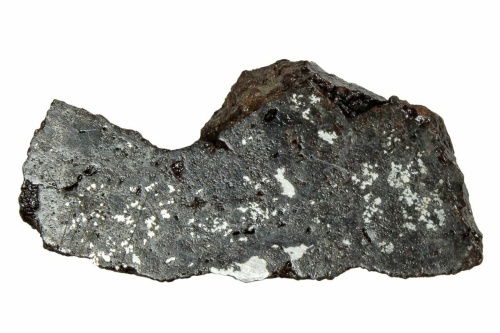
Stony Meteorites are quieter in appearance but no less significant. Their value often lies in subtle textures and scientific importance rather than visual drama.
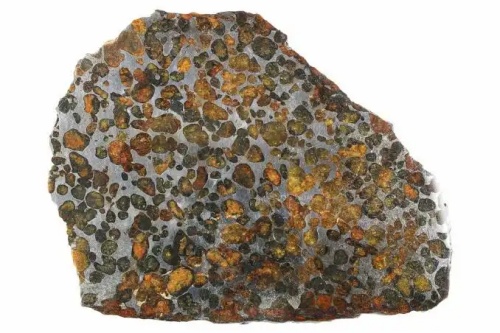
Pallasites, among the rarest, sit somewhere between the two — translucent olivine crystals suspended in iron. They are fragments of planetary boundaries, and perhaps the closest thing we have to holding a planet’s interior.
Stones Commonly Mistaken for Meteorites
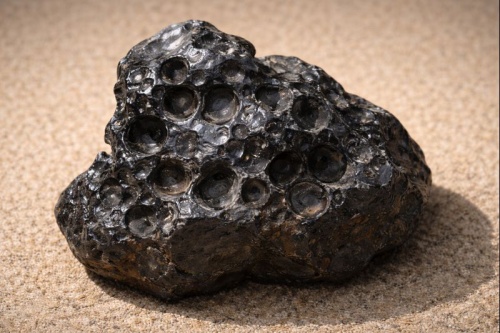
Most false meteorites are not intentional frauds. Slag from industrial processes, weathered volcanic rocks, or iron-rich Earth formations can be convincing at first glance.
What they lack is coherence. Bubbles appear where they should not. Weight feels wrong. Magnetism is inconsistent. With time, these differences become obvious.
The image on the right is an example for fake meteorite.
How to Verify a Meteorite’s Authenticity
Over time, one learns that verifying a meteorite is rarely about a single test or dramatic proof. Authenticity reveals itself through consistency — when the story, the material, and the physical evidence all align.
A genuine meteorite should make sense from every angle. Read more about my journey to University of Berne to the lab for Meteorite Classification
Provenance Comes First
Whenever possible, the origin of a meteorite should be known. This does not always mean a famous fall or a museum label, but there should be a clear trail: where it was found, when it entered a collection, and how it has been handled since. Specimens accompanied by written documentation, old collection tags, or reliable seller records carry a weight that extends beyond the stone itself. Provenance anchors a meteorite in reality.
A clear example is the Sikhote-Alin meteorite, recovered from the famous iron meteorite fall in eastern Russia on February 12, 1947. Specimens preserved with original stamps and documentation remain firmly tied to this historic event, giving them enduring scientific and collector value.
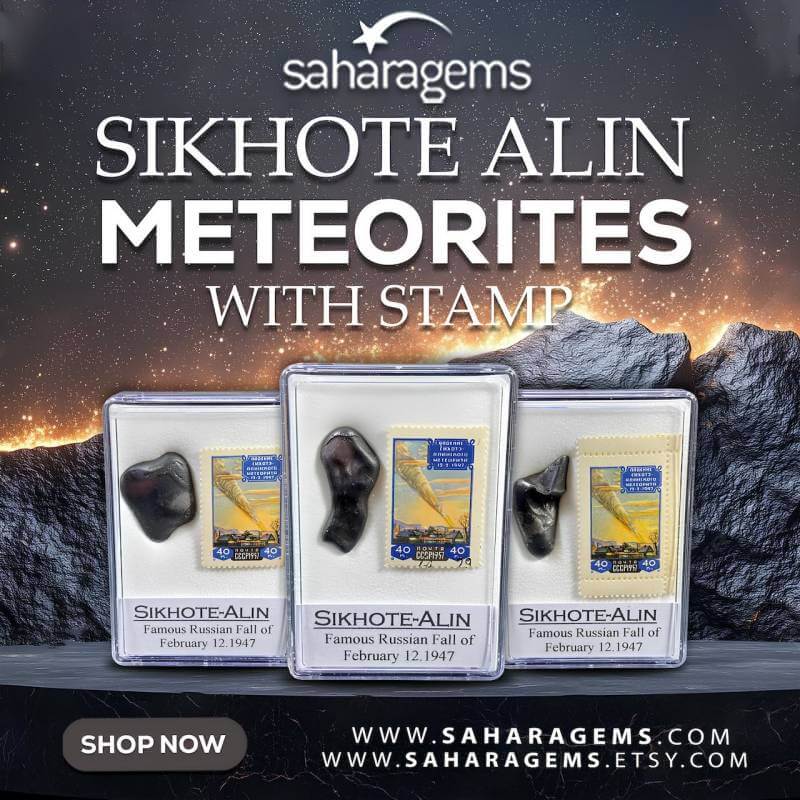
click here to view more about this meteorite
Physical Characteristics Must Agree
Authentic meteorites tend to display a quiet internal logic. Weight, magnetism, surface texture, and internal structure should support one another rather than contradict. A stone that is strongly magnetic but unusually light, or one that looks metallic yet shows gas bubbles, raises immediate questions. Real meteorites rarely present such inconsistencies.
Experience teaches that doubt usually has a reason.
Classification and Scientific Testing
For higher-value specimens, formal classification may be available. This can include chemical analysis, nickel content testing, or petrographic examination. While not every authentic meteorite is classified, those that are have passed through the hands of specialists who understand what Earth rocks cannot imitate. When scientific data is present, it speaks clearly.
The Importance of Trusted Sources
Perhaps the most overlooked aspect of verification is the seller. Reputable collectors and dealers tend to share information freely — provenance, photographs, and context are offered without hesitation. Transparency is rarely forced; it comes naturally when a specimen’s history is sound.
Within the meteorite world, this culture of accountability is supported by established collector communities. One of the most widely recognized is the International Meteorite Collectors Association (IMCA). The IMCA exists to help collectors acquire authentic meteorites with confidence and to promote ethical standards within the trade.
IMCA members are bound by a Code of Ethics and Association Bylaws, which require accurate representation, honest disclosure, and traceable provenance. Members are identifiable by a unique IMCA number, allowing buyers to independently verify a seller’s identity through the public member registry. This simple mechanism adds an important layer of trust in a field where material is rare and verification matters.
Hesitation, vague answers, or pressure to buy quickly often signal uncertainty rather than rarity. In contrast, trusted sources welcome questions, encourage verification, and allow the material to speak for itself.
Collectors who take the time to buy from established dealers, documented collections, or recognized associations tend to build collections grounded not only in material authenticity, but in long-term credibility.
Storage and Condition Over Time
Authentic meteorites age in recognizable ways. Iron meteorites may oxidize if poorly stored; stony meteorites may show subtle weathering.
Stones that appear artificially altered or unnaturally uniform often tell a different story — one shaped more by tools than time.
When in Doubt, Step Back
Verification is not a race. The most valuable pieces are rarely lost to patience. Taking time to compare, question, and consult often prevents costly mistakes.
Collectors who slow down tend to build better collections.
A Quiet Rule Among Collectors
A useful principle remains true:
If a meteorite’s story feels incomplete, it usually is.
Authenticity is not about belief — it is about alignment.
Meteorite Value & Collectability
Meteorite value is shaped by rarity, classification, condition, and provenance. Some specimens are modest and accessible; others are rare fragments from well-documented falls or historic finds. What gives a meteorite lasting worth is not only price, but context — knowing where it came from, how it was identified, and how it fits into the broader story of our solar system.